
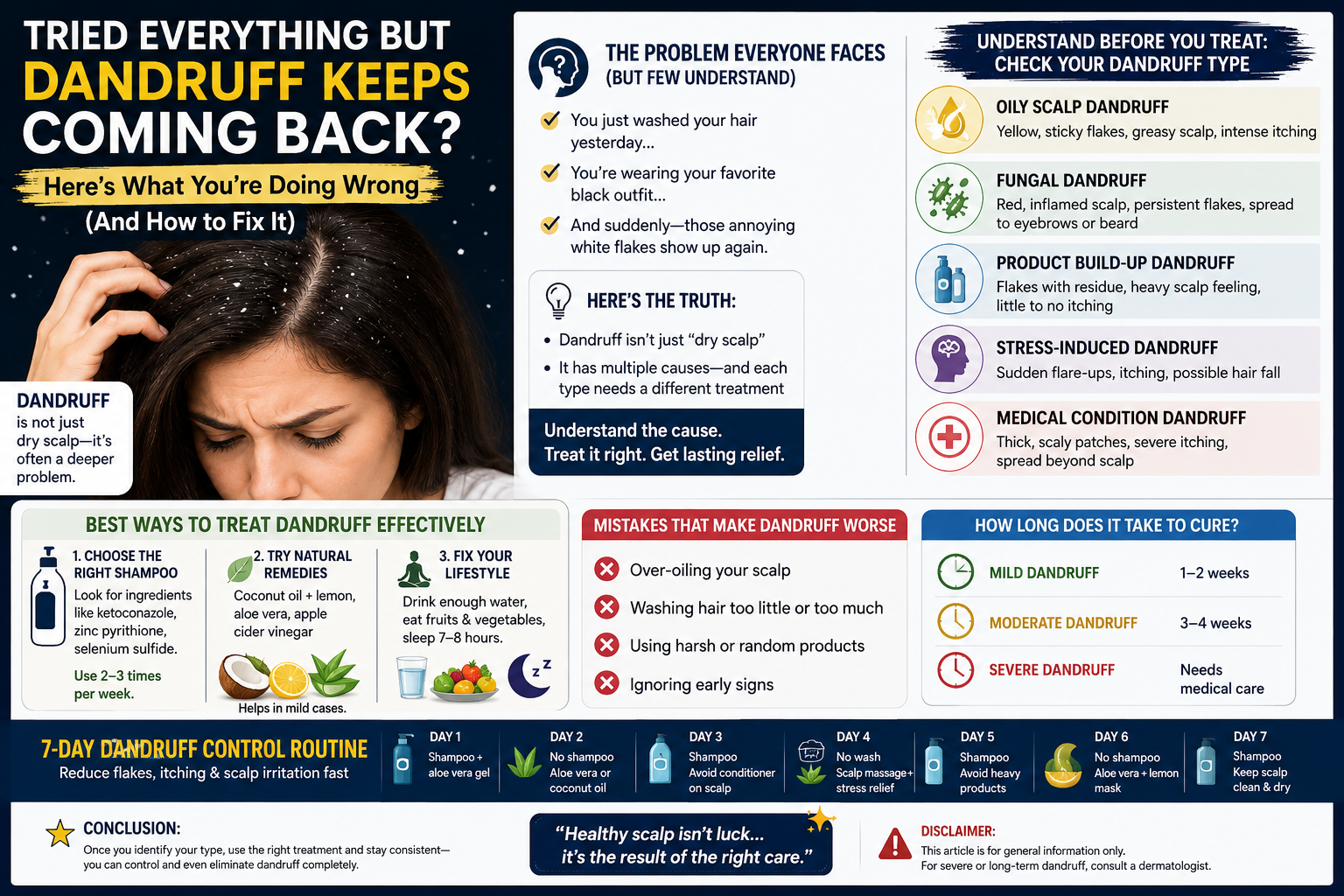
The Ultimate Guide to Understanding, Treating & Preventing Dandruff for Good
The Problem Everyone Faces (But Few Understand)
You just washed your hair yesterday…
You’re wearing your favorite black outfit…
And suddenly—those annoying white flakes show up again.
Sound familiar?
Dandruff is one of the most common scalp issues, yet one of the most misunderstood. Most people try random shampoos, home remedies, or oils—only to see it come back again and again.
Here’s the truth:
👉 Dandruff isn’t just “dry scalp”
👉 It has multiple causes—and each type needs a different treatment
Until you understand why it’s happening, you’ll keep fighting the same battle.
Let’s break it down in the simplest way possible 👇
🔍 What Exactly is Dandruff?
Dandruff is a condition where your scalp sheds dead skin cells excessively, often with itching, irritation, or redness.
A major hidden cause behind many cases is a naturally occurring fungus called Malassezia.
This fungus feeds on oil (sebum) on your scalp. When it grows too much, it irritates the skin—leading to flakes, itching, and inflammation.
So dandruff is not just dryness—it’s often a biological imbalance on your scalp.
⚠️ Common Signs You Should not Ignore
You should not ignore white or yellow flakes appearing on your hair and shoulders. You may also experience constant itching on your scalp, which can feel uncomfortable and irritating. In some cases, the scalp may develop oily or dry patches, making it look uneven or unhealthy. Redness or irritation is another common sign that indicates your scalp is not in good condition.
If these symptoms are ignored for a long time, dandruff can worsen and may even lead to hair fall and scalp infections.
Understand Before You Treat: Check Your Dandruff Type
Before jumping into treatments, it’s important to understand what type of dandruff you actually have. Understanding given below signs helps you choose the right treatment instead of using random products that may not work.
| Oily Scalp Dandruff | ||||||||
|
Fungal Dandruff
| Category | Details |
| ✔️ Why it happens | Fungal overgrowth and scalp inflammation, often linked to Seborrheic Dermatitis |
| ✔️ How to identify | Red, inflamed scalp, persistent flakes, and possible spread to eyebrows or beard |
| ✔️ What works | Use medicated shampoos (ketoconazole, selenium sulfide) and antifungal treatments |
Product Build-Up Dandruff
| Category | Details |
| ✔️ Why it happens | Excess use of styling products like gel, spray, or dry shampoo |
| ✔️ How to identify | Flakes mixed with residue, heavy scalp feeling, and little to no itching |
| ✔️ What works | Use a clarifying shampoo and reduce product usage |
Stress-Induced Dandruff
| Category | Details |
| ✔️ Why it happens | Mental stress weakening the skin barrier and causing imbalance |
| ✔️ How to identify | Sudden dandruff flare-ups, itching, and possible hair fall |
| ✔️ What works | Practice stress management (yoga, meditation), maintain good sleep routine |
Medical Condition Dandruff
| Category | Details |
| ✔️ Why it happens | Linked to skin conditions like Psoriasis and Eczema |
| ✔️ How to identify | Thick, scaly patches, severe itching, and spread beyond the scalp |
| ✔️ What works | Consult a dermatologist and follow prescribed medical treatment |
Best Ways to Treat Dandruff Effectively
Choosing the right shampoo is the first and most important step in treating dandruff. You should look for ingredients like ketoconazole, zinc pyrithione, and selenium sulfide, as they help control dandruff effectively. For best results, this type of shampoo should be used two to three times a week.
For mild cases of dandruff, natural remedies can also be helpful. Simple options like coconut oil mixed with lemon, aloe vera, and apple cider vinegar can soothe the scalp and reduce flakes. However, it is important to understand that these remedies work best only in early or mild dandruff and may not be effective for severe conditions.
Improving your lifestyle also plays a key role in controlling dandruff. Drinking enough water helps keep your scalp hydrated, while eating fruits and vegetables provides essential nutrients for scalp health. Getting proper sleep of seven to eight hours supports overall skin health and helps prevent dandruff from worsening.
Mistakes That Make Dandruff Worse
Certain habits can make dandruff worse if not avoided. Over-oiling your scalp can actually increase the problem, as excess oil can promote the growth of Malassezia. Washing your hair too little or too often can also disturb the natural balance of your scalp, leading to more flakes and irritation. Using harsh or random hair products may damage the scalp and worsen dandruff instead of treating it. Lastly, ignoring early signs like mild flakes or itching can allow the condition to become more severe over time.
How Long Does It Take to Cure?
The time required to treat dandruff depends on how severe the condition is. Mild dandruff can usually be controlled within one to two weeks with proper care and the right products. Moderate dandruff may take around three to four weeks to improve noticeably. However, in severe cases, dandruff may not go away with basic treatments and will require proper medical care and guidance.
You can try this 7-Day Dandruff Control Routine to Reduce Flakes, Itching & Scalp Irritation Fast
| Day | 🧴 What to Do | 🌿 Extra Care | 💡 Why It Works |
| Day 1 | Wash hair with anti-dandruff shampoo (leave for 3–5 mins) | Apply aloe vera gel at night | Reduces fungus like Malassezia and deep cleans scalp |
| Day 2 | No shampoo | Apply light aloe vera or little coconut oil | Soothes scalp without increasing oil |
| Day 3 | Shampoo again (leave for 5 mins) | Avoid conditioner on scalp | Breaks dandruff cycle caused by Malassezia |
| Day 4 | No wash | Gentle scalp massage + stress relief | Improves blood circulation & healing |
| Day 5 | Shampoo (anti-dandruff or clarifying) | Avoid heavy styling products | Removes buildup + controls flakes |
| Day 6 | No shampoo | Apply aloe vera + lemon mask (20–30 mins) | Balances scalp pH & reduces itching |
| Day 7 | Final shampoo (leave for 5 mins) | Keep scalp clean & dry | Prevents dandruff from coming back |
🌟 Conclusion: The Real Secret to a Flake-Free Scalp
Dandruff is not just about flakes—it’s your scalp asking for attention.
If you keep changing products without understanding the cause, it will keep coming back.
But once you:
✔️ Identify your dandruff type
✔️ Use the right treatment
✔️ Stay consistent
You can control—and even eliminate—it completely.
“Healthy scalp isn’t luck… it’s the result of the right care.”
Start today. Because when your scalp is healthy, your confidence naturally shines ✨
⚠️ Disclaimer
This article is for general information only. For severe or long-term dandruff, consult a dermatologist.